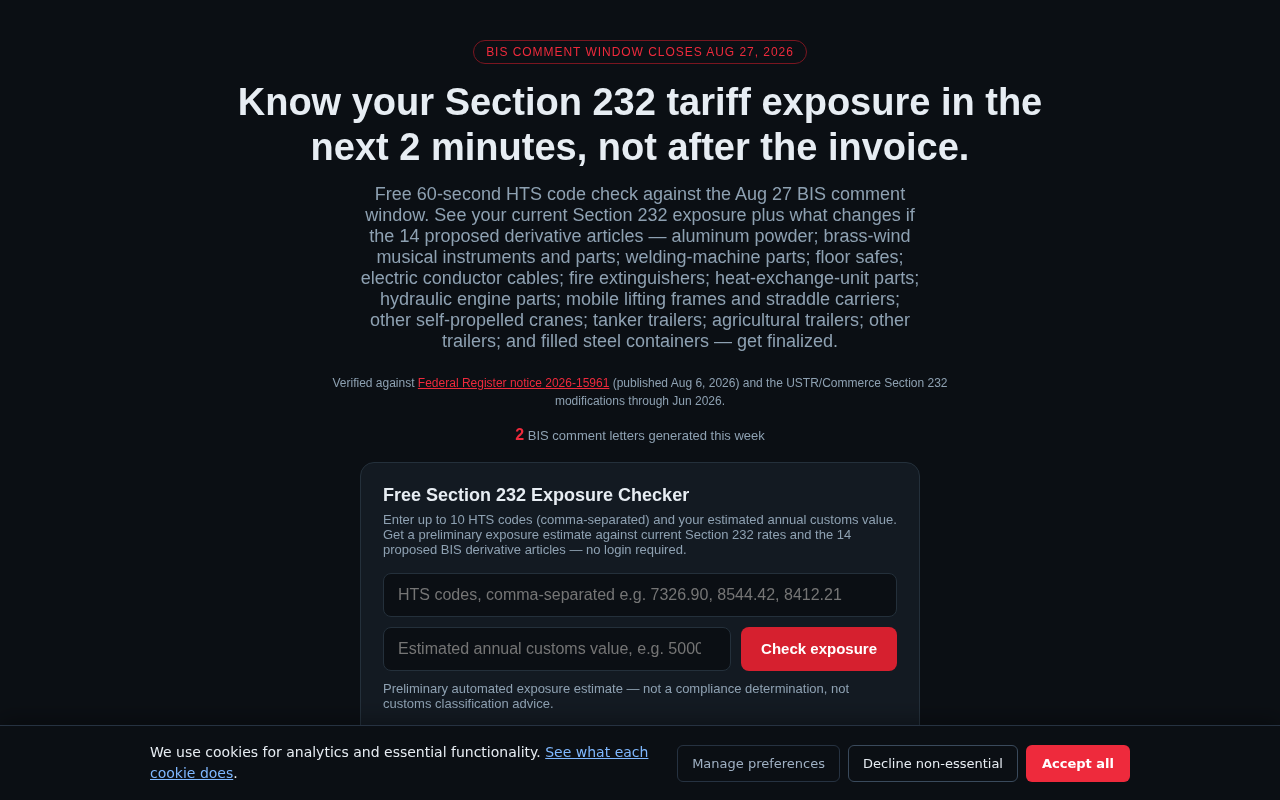
20 real questions on Section 232, BIS Notice 2026-15961, and the inclusion-rebuttal process — with plain-language answers grounded in Federal Register, 19 U.S.C., 15 CFR, and CBP CSMS primary sources.
What does TariffWatch cost?
The HTS lookup tool is free — use it right now, no signup. The Watchlist is $29/mo: we monitor your specific HTS codes against BIS inclusion requests and Federal Register actions, with alerts and a weekly digest. One-time packages: the Comment Filing package at $49 (file an opposition comment against an inclusion request, guided end-to-end) and the Inclusion Rebuttal package at $99 (full rebuttal build for a request that directly targets your products).
Why are there one-time purchases and a subscription?
Because the problem has two shapes. Monitoring is continuous — inclusion requests appear on BIS's schedule, not yours — so the Watchlist is monthly. But when a specific request threatens your product, that's an event: you fight it once, hard, inside a 14-day comment window. Pay for the fight when there's a fight.
Is there a free trial on the Watchlist?
Yes — full access up front, downgrade if it's not for you. And the free HTS lookup means you can confirm we correctly understand your product's tariff exposure before spending anything. If the lookup impresses you, the Watchlist is the same engine running continuously on your behalf.
Refunds?
Watchlist annual: 30-day money-back. Watchlist monthly: trial first, and genuine problems handled case-by-case at support — we don't advertise a window, we just behave decently. One-time packages ($49/$99): if we fail to deliver the package as described, full refund; if you used the filing and the government ruled against you, that's the government, not the deliverable — but talk to us anyway.
What data do you need from me?
Very little: your email and the HTS codes you care about. We don't need entry documents, supplier names, or transaction values for monitoring — the watchlist works on codes alone. If you buy a filing package, you'll share product details needed for the arguments, which stay between us.
Is my watchlist confidential? My HTS interest is competitively sensitive.
Yes, and we understand why you're asking — a watchlist is a map of your supply chain exposure. Your codes are never shared, sold, aggregated into public stats, or visible to other customers. Encrypted in transit and at rest, US infrastructure, access limited and logged.
What does TariffWatch actually do?
It watches the Section 232 derivatives process for you: monitors BIS inclusion requests, Federal Register notices, and proclamation changes against your specific HTS codes, then alerts you with plain-English impact — "a request was filed to add your code to the steel derivatives list; comment window closes in 14 days." Plus the free HTS lookup, filing packages when you need to fight, and a weekly digest.
What are "inclusion requests" and why should I care?
Domestic steel and aluminum producers can petition BIS to add derivative products — by HTS code — to the Section 232 tariff lists. If a request covering your code succeeds, your imports get hit with the 50% tariff on the steel/aluminum content. These requests are filed during three annual windows (May, September, January), and the public comment period on each is short. Miss it, and the first you hear is your broker's invoice.
How fast do I get alerted when something affects my codes?
Same day as publication, typically within hours — our cron polls the Federal Register API and BIS continuously. Speed matters here more than almost anywhere: comment windows on inclusion requests run about 14 days from posting, and building a real opposition takes most of that.
How long does setup take?
Minutes. Run the free HTS lookup to confirm your codes, add them to your Watchlist, done. No integrations, no imports, no IT ticket. The hard part of this problem was never setup — it was knowing what happened in the Federal Register this morning.
My customs broker already tells me about tariff changes.
Brokers tell you about changes that have *landed* — usually when the duty bill arrives. Almost no broker monitors pending BIS inclusion requests per client HTS code, because that's forward-looking regulatory surveillance, not entry filing. By the time a change reaches your broker's workflow, the comment window where you could have fought it is closed. We work upstream of your broker.
Versus hiring a trade attorney?
Trade counsel is irreplaceable for strategy and formal proceedings — at $400-800/hr. But paying counsel to *watch the Federal Register* is lighting money on fire. The efficient split: TariffWatch monitors ($29/mo) and handles standard comment filings ($49-99); counsel handles what genuinely needs a lawyer. Several attorneys use us for exactly this reason.
Tariff policy changes so fast that monitoring feels pointless.
Flip that around: policy changing fast is the *reason* monitoring exists. When rules were stable, nobody needed a watchlist. The 232 derivatives process now moves in structured windows (May, September, January) with real deadlines — fast, but trackable. Chaos you can't see is a threat; chaos you're watching is a planning input.
We only import finished goods, not steel or aluminum.
The derivatives lists are exactly about finished goods — the tariff applies to the steel and aluminum *content* of downstream products. Appliances, furniture components, auto parts, hardware — codes people swore were "not a steel product" have been added by inclusion. Run the free HTS lookup; it takes two minutes to know whether this paragraph applies to you.
$29/mo for email alerts?
For $29/mo you get continuous per-code surveillance of a process where a single missed comment window can mean a permanent 50% tariff on the metal content of your imports. One container's worth of unexpected 232 duty typically costs more than a decade of the Watchlist. It's the cheapest asymmetric bet in your import budget.
What legal authorities does TariffWatch monitor?
Section 232 of the Trade Expansion Act of 1962 (19 U.S.C. §1862) as implemented through the steel and aluminum proclamations — from Proclamations 9704/9705 (2018) through the 2025 actions that ended exclusions and raised rates to 50% (effective June 4, 2025) — plus the BIS inclusions process for derivative products and every related Federal Register publication. Alerts cite the specific document, always.
Is TariffWatch legal advice? Are the filing packages legal representation?
No and no. We're a monitoring and document-preparation service — the comment and rebuttal packages structure *your* submission with *your* facts; you (or your counsel) file as yourself. For matters needing a licensed trade attorney, we'll say so explicitly rather than upsell you a package that shouldn't carry the weight.
Can I cancel the Watchlist anytime?
Yes, self-serve, effective end of period. Your watchlist configuration and alert history stay attached to your account, because tariff exposure has a way of becoming urgent again in May, September, and January.
What exactly is in the $49 Comment Filing package?
A guided build of a formal opposition comment against a BIS inclusion request affecting your HTS codes: argument structure, the economic-impact framing BIS actually weighs, formatting for the docket, and filing instructions with the deadline tracked for you. What takes trade counsel a billable afternoon, structured for you at $49.
What's in the $99 Inclusion Rebuttal package versus the $49 one?
The rebuttal package is for when an inclusion request directly targets your product line — deeper treatment: full rebuttal document assembly, domestic-availability and substitutability arguments, supporting-evidence checklist, and review before filing. The $49 comment is a strong voice in the docket; the $99 rebuttal is a defense brief.